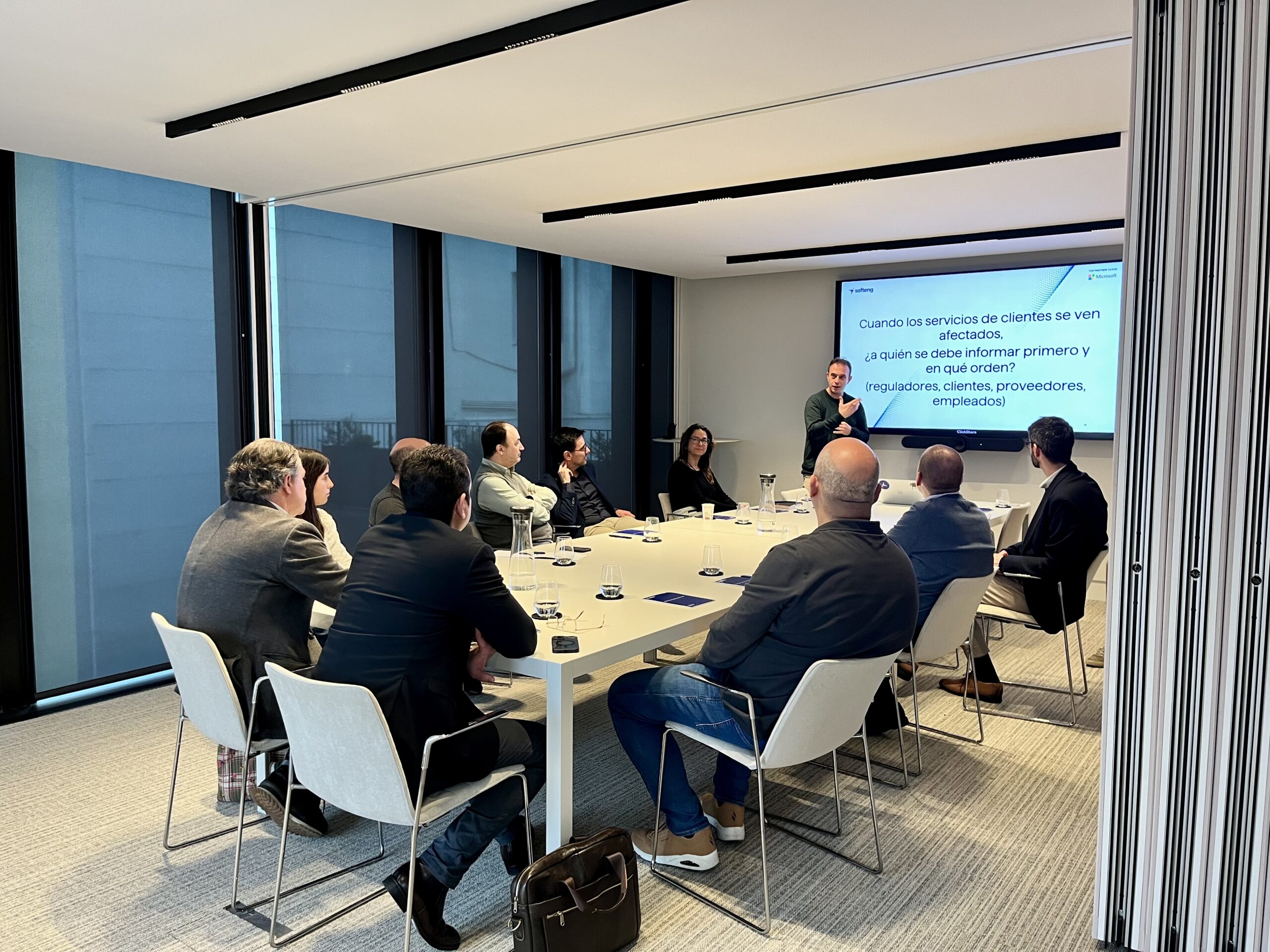
We gathered at the offices of Softeng business managers and heads of Cybersecurity in a Technology Breakfast focused on an increasingly crucial issue in organizations: what to do to prevent a security breach does not become a business crisis.
Many companies still approach cybersecurity only from an operational focus: detect, contain and recover. However, when there is compromised data, critical services down or public exposure, the focus changes completely.
In this context, Softeng has organized a Technology Breakfast under the following premise: in a security breach, the impact is not only measured in affected systems, but how it affects business continuity, regulatory compliance and business confidence.
The meeting was organized in collaboration with the firm specialized in digital law and compliance, Ribas & Asociados, and brought together executives from leading companies: Girbau, RUBI Group, Grupo Lantero, Hotel Majestic, RBA, Nature Bissé and Intress.
“A very interesting point of these meetings is that it allows you to know the problems that other companies have and that is what helps you to know how they solve those problems.”
Gil Riera, CTO of Girbau.
Key insights from the meeting
The breakfast included a practical table-top exercise (TTX), designed by Softeng, in which attendees participated in decision-making in a scenario of ransomware with impact on data and critical operations.
This type of dynamics allows us to detect common weaknesses: poorly defined roles, unforeseen dependencies, lack of alternative communication channels or doubts about who should lead the crisis committee at key moments.
“All C-Levels play a very important role in a crisis situation and a full TTX is a good exercise to be well prepared to be able to react in the shortest possible time.”
Inma Rasero, Partner and Commercial Director of Softeng.
From Softeng focused on that, after a security breach, it is essential to have all the information necessary to understand its impact on the business. For that, companies must join the signals and alerts of security tools with business context that allows them to assess scenarios, prioritize actions and activate protocols quickly, before time plays against.
For its part, the participation of the firm Ribas y Asociados provided the legal and regulatory vision necessary to understand how regulations such as GDPR or NIS2 directly influence the management of a crisis. Not as a brake, but as a framework that requires informed and documented decisions, especially in the first hours.
Prepare to decide, not only to prevent
The session closed with a shared reflection: prevention is essential, but it does not eliminate the need to be prepared to manage a real crisis.
The organizations that respond best are not those that never experience incidents, but those that have worked out in advance how to decide, communicate and coordinate when everything speeds up.
From Softeng, we organize such meetings to share real experiences, generate conversations between professionals and help organizations to reflect on how to prepare for scenarios that are already part of everyday life.
“I would recommend the Softeng Tech Breakfast to any technology and business profile because it brings you value; it helps us to clarify ideas and prepare for any type of incident.”
Miguel Ángel Aranda, IT Manager of RUBI Tools Group.